
Why Midlife Weight Gain Feels Unstoppable—And What’s Actually Going On Inside Your Body
One day your jeans fit. The next, you can’t even do up the button.. And nothing you’re doing explains why. (Spoiler: it’s not the dryer)
Based on feedback from our community, weight gain is one of the two most distressing perimenopause symptoms—right alongside insomnia. Women everywhere say the same things:
“I’m eating healthier than ever, exercising more, and somehow gaining weight.”
“My doctor told me to eat less. Not helpful.”
“Everything is tighter and I swear I haven’t done anything to deserve this.”
Good luck taking your mind off the subject this time of year.
Between Thanksgiving and the December holiday marathon, we’re inundated with messages to watch out for holiday food temptation. Then January arrives with its annual avalanche of weight-loss content—most of which doesn’t help women in midlife.
Time to cut through the noise with what’s actually happening.
Why Perimenopause Changes Your Body (The Real Story)
Here's what the research actually shows: women gain weight gradually through midlife—roughly 0.5 to 0.7 kg (1–1.5 lbs) per year on average. This is largely due to aging, not menopause specifically.
But here's the crucial part that gets lost: menopause dramatically changes where and how your body stores fat, even when the scale doesn't move much.
During the menopause transition, visceral fat (the deep abdominal fat around your organs) increases from about 5–8% of total body weight to 10–15%. Meanwhile, you're losing lean muscle mass as you age.
So you might weigh roughly the same while your body composition shifts dramatically. Your clothes fit differently. Your waistline expands. And the metabolic consequences are real.
This isn't failure. This is biology.
But understanding biology doesn't mean accepting it passively. Once you know what's driving these changes, you can work with your body instead of against it.
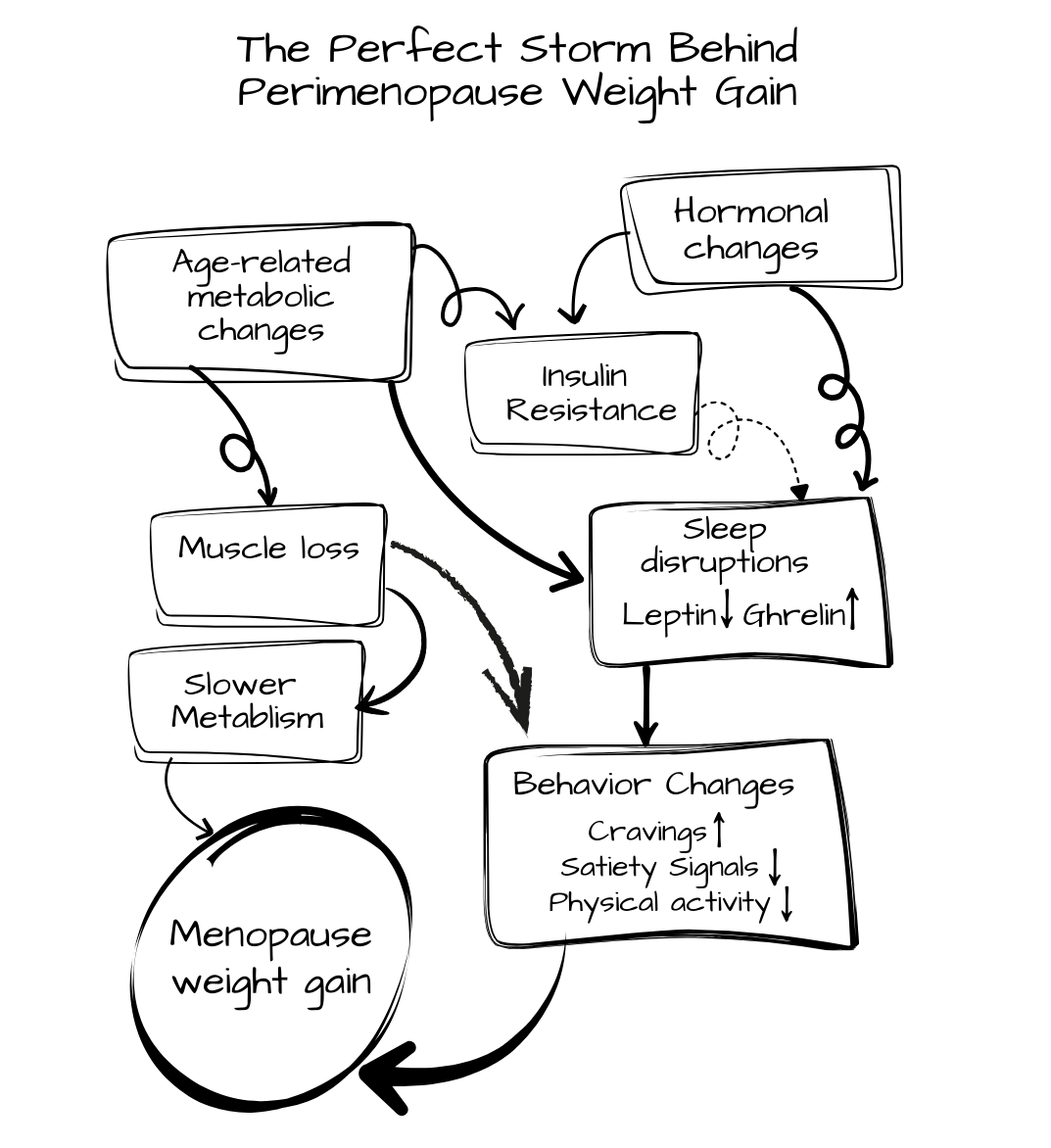
What's Driving These Changes
1. Hormones → Appetite, Fat Distribution, and Cravings
Estrogen isn't just a reproductive hormone. It plays major roles in appetite regulation, leptin sensitivity (your fullness signal), serotonin production (your mood stabilizer), fat distribution patterns, and blood sugar control.
When estrogen fluctuates or drops, you may experience increased hunger, weakened fullness signals, stronger responses to carb-heavy foods, and a shift from hip/thigh fat storage to abdominal fat storage.
Progesterone decline adds sleep disruption and mood changes to the mix, which can worsen cravings and nighttime eating.
You're not imagining it; your biology is louder than your willpower.
2. Sleep Disruption → Metabolic Chaos
Night sweats, anxiety, 3 a.m. wakeups… Fluctuating estrogen and progesterone levels wreak havoc on both the quantity and quality of your sleep.
Poor sleep triggers higher ghrelin (hunger hormone), lower leptin (fullness hormone), higher cortisol (which promotes abdominal fat storage), reduced insulin sensitivity (easier blood sugar spikes), and lower metabolic rate.
The result? Sleep-deprived people consume an average of 300–500 extra calories per day, mostly from carbs and fats. It’s not weakness; it’s biology.
3. Muscle Loss → A Slower Metabolism
Starting in our 30s, we begin losing muscle. During perimenopause, hormonal shifts accelerate this loss.
Less muscle means a lower resting metabolic rate. A lower resting metabolic rate means the same meals now lead to weight gain.
This is why so many midlife women feel like they're "running just to stay still."
4. Insulin Resistance: The Silent Saboteur
Here's something most women aren't told: perimenopause can make it harder to process sugar, even if you haven't changed how you eat.
When estrogen fluctuates, your body may become less responsive to insulin. This can lead to easier blood sugar spikes, higher circulating insulin levels, increased abdominal fat storage, more cravings, and more dramatic energy crashes.
Many women say: "I gain weight just looking at bread."
Not imagined. Not personal failure. A measurable metabolic shift.
5. Individual Variation Matters
It's worth noting that these patterns aren't universal. The SWAN study found different trajectories across ethnic groups. For instance, Japanese American and Chinese American women in the study did not show the same weight gain patterns during the menopause transition. Genetics, starting body composition, activity levels, and previous dieting history all influence how your body responds.
Why So Many Midlife Women Turn to GLP-1s
It's no coincidence that GLP-1 medications have skyrocketed among women in midlife. Some surveys show that women make up the clear majority of non-diabetic GLP-1 users. Again, it’s not because women lack discipline, but because midlife physiology makes weight management genuinely harder. Their popularity reflects the limitations of traditional 'eat less, move more' advice in perimenopause and menopause.
But for many women, a smarter approach to lifestyle change works: one that’s comprehensive, and built on understanding the biology—not fighting it.
What Actually Helps (The Evidence-Based Playbook)
No detox teas. No punishment workouts. Just physiology-informed strategies.
1. Strength Training
The #1 intervention for midlife metabolism.
Strength training restores muscle, increases metabolic rate, improves insulin sensitivity, and can reduce abdominal fat.
Aim for 2–3 sessions per week. Influencers say "lift heavy." Science says lift what you can safely with proper form, within 1–2 reps of failure (meaning: do as many reps as you can with proper form, minus 1 or 2).
If you're overwhelmed, start with 10 minutes, or do bodyweight squats or pushups when you have a free moment.
2. Protein + Blood Sugar Balance
Aim for 25–30g of protein per meal, or approximately 1.2–1.6g per kg of body weight per day. If you're very active, you may benefit from the higher end of this range (some experts recommend up to 1.8g/kg for active midlife women).
This preserves muscle, improves satiety, and steadies blood sugar.
Each meal should include protein, fiber, and healthy fats. This combination helps avoid the spikes and crashes that drive hunger and fat storage.
Finish your last meal 2–3 hours before bed. And if you need a bedtime snack, make it small, protein-forward, and sugar-free (Greek yogurt or peanut butter are good options).
A gentle 12–14-hour overnight fast helps some women improve insulin sensitivity—but it's optional and not right for everyone.
3. Prioritize Sleep
Treat sleep like a medical intervention.
Try: a consistent sleep/wake time (this is key!), a cool and dark bedroom, limiting screens before bed, minimizing ambient noise or using white noise to mask it, and avoiding caffeine after noon.
If insomnia is chronic, CBT-I (cognitive behavioral therapy for insomnia) is highly effective. Some women find magnesium glycinate or melatonin helpful.
4. Rethink Alcohol
Alcohol deserves its own mention—not just as a sleep disruptor, but as a metabolic factor.
Beyond fragmenting sleep (even when you think you're sleeping through the night), alcohol affects estrogen metabolism, contributes empty calories, and can trigger cravings the next day. Many women find that reducing or eliminating alcohol has an outsized impact on how they feel and how their body responds.
Try minimizing or cutting out alcohol, especially in the 4 hours before bed.
5. Manage Stress
Chronic stress = chronic cortisol = chronic belly fat.
Small practices, big payoff: breathing exercises, gentle yoga, journaling, and daily outdoor movement all help regulate your stress response.
6. Medical Support Options
Menopause Hormone Therapy (MHT) can improve sleep, help prevent the shift to visceral fat storage, stabilize insulin sensitivity, and support overall metabolic health. Research shows MHT is associated with reduced total and visceral fat and may help prevent the age-associated gain in fat mass.
MHT is not a weight-loss drug—but for many women, it's a powerful metabolic stabilizer.
Consider testing: thyroid function, cortisol, fasting glucose + insulin, and lipids.
Work with a clinician who understands midlife physiology—not one who just repeats "try harder."
Where to Start Today
Add protein to your next meal
Take a 10-minute walk after eating
Schedule two strength-training sessions this week
Set a consistent bedtime
Swap one refined carb for a whole grain
Reduce alcohol by one drink this week
Choose 1 or 2 per week and start stacking good habits. Small steps, big impact.
The Takeaway
Midlife body changes are common. They're frustrating. And they've been wildly misunderstood.
You're not failing. You're not imagining it. You're not "letting yourself go."
Your physiology is shifting—and now your toolkit can shift too.
Knowledge is power.
For personalized answers to your menopause questions, download Ask Elina here.